
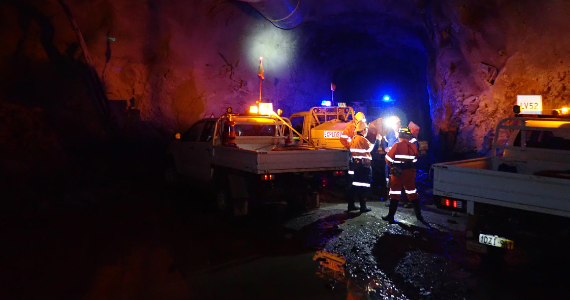
The valuable work of ChemCentre researchers and the contribution of good science to ensuring a safe workplace has been highlighted with the State Government’s announcement of a new workplace exposure standard for diesel particulate matter for all WA mines.
ChemCentre scientist Dr Silvia Black led a research project working with Curtin University which examined how mine ventilation systems can be optimised to limit exposure of workers to diesel emissions and exhaust gases in underground mines.
DPM is a component of diesel engine exhaust which is a known health hazard for the mining industry, particularly underground mines.
The project was part of wider research aimed at better protecting the health of underground mine workers.
The mine ventilation system plays an important role in reducing the extent to which underground miners are exposed to diesel emissions, exhaust gases and heat. The mine’s secondary ventilation systems are critical for diluting contaminants when working at the face of a heading.
Silvia’s team conducted a tracer gas study to measure flow behaviours and differentiate between the contribution of various contaminant sources including nano diesel particulate matter (nDPM).
This research was undertaken in collaboration with BBE Consulting Australasia and was funded by Department of Mines, Industry Regulation and Safety (DMIRS) and the Minerals Research Institute of Western Australia (MRIWA).
Find out more about the The Tracer Gas Study of Nano Diesel Particulate Matter (nDPM) Behaviour in Secondary Ventilation Practices project.
Read the Minister’s announcement here.