
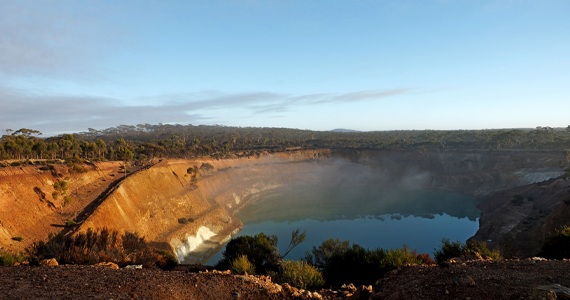
Transforming mine pit lakes from legacy risks into future assets takes world-class science, and ChemCentre is proud to be leading the national research moving Australia closer to that goal.
Led by ChemCentre Senior Scientist Dr Kathryn Linge, in collaboration with CSIRO, University of Western Australia, University of Queensland, Flinders University and Curtin University, CRC TiME Project 4.9 Mine Pit Lake Assessment and Management: A National Initiative to Support Mine Closure and Regional Opportunities, is advancing the science needed to help support responsible mine closure and explore the future potential of pit lakes across Australia.
When mining operations cease, large mine voids remain where land cannot be refilled, and these voids often extend below the natural water table. Gradually, groundwater, rainwater and surface runoff accumulate, forming permanent pit lakes.
Western Australia alone has an estimated 1,336 mine pit lakes or pit voids, ranging from dry and partially wet areas to deep, water-filled lakes that can extend for kilometres. During active mining, water is continuously pumped out to make operations possible. Once pumping stops, these voids naturally begin to fill, sometimes slowly via groundwater, sometimes rapidly through rivers and rainfall.
These emerging waterbodies represent both opportunity and challenge. Pit lakes may become valuable regional water resources with significant economic, cultural, social and environmental benefits. However, they also present environmental, geochemical and safety concerns that require careful planning, predictive science and long-term management. Regulatory and technical limitations currently restrict widespread beneficial reuse, something this project seeks to address.
Established in 2020 as part of the Australian Government's Cooperative Research Centre program, the Cooperative Research Centre for Transformations in Mining Economies (CRC TiME) is striving to help transform mine closures from a final step in the mining lifecycle into opportunities for regional economic development, environmental restoration, and community benefit. CRC TiME is the first research centre of its kind globally, focused entirely on supporting the delivery better outcomes when mining ends.
With the project schedule for completion in 2027, the research team will continue developing numerical modelling and practical decision-support tools to guide closure planning and repurposing options, along with documenting sustainable post-mine lake uses. ChemCentre looks forward to sharing further project updates and outputs as the project progresses.
Project Milestone: Two newly released interim reports.
With the project well underway, ChemCentre is pleased to announce the publication of two CRC TiME interim research reports:
Towards Effective Pit Lake Management: A survey on pit lake classification and pit lake types of national importance
Co-authored by researchers from ChemCentre, CSIRO and Curtin University, this report captures key findings from a national stakeholder survey exploring priorities and perspectives relating to pit lake characteristics, risks and potential uses. These insights will directly inform the development of a pit lake categorisation and risk assessment tool, ensuring practical relevance to industry, regulators, communities and Traditional Owners.
Review of models used to simulate hydrological and geochemical issues related to closure of open pit mines
Co-authored by researchers from Flinders University, CSIRO, University of Queensland and University of Western Australia, this report reviews current modelling science used to predict long-term water and chemistry behaviour in pit lakes. The synthesis provides a foundation for improving closure planning and supports more accurate forecasting, risk assessment and sustainable long-term management.
Stay up to date with other CRC TiME research news and events